Synthetic Neurocomputers for Cognitive Information Processing
Background
We all know artificial intelligence (AI), which is based on deep-neural-network models. AI has transformed the state of the art in many domains, such as speech and visual-object recognition and drug discovery. In fact, current AI has already outperformed humans in some complicated tasks, marked by two landmark demonstrations: Google’s AlphaGo defeating human champions at Go, and IBM’s Watson winning the quiz show Jeopardy!.
However, despite the impressive progress, the capability of current AI technologies is still far from that of human brains. One key bottleneck is that even the most advanced silicon-based semiconductor devices perform information processing with orders of magnitude lower energy efficiency compared to neural cells. Moreover, the information processing and learning algorithms in current deep-neural-network models are only bio-inspired but not bio-identical. Current deep-learning models are based only on our limited knowledge of the inner working principles of neurons and synapses (hence artificial neurons and synapses), and on the restricted functionality of conventional semiconductor devices and interconnects. In biological neural networks, by contrast, neurons can fire asynchronously in parallel, with information carried by the signal amplitude, firing frequency, or firing mode, which leads to more complex and energy-efficient learning and computing.
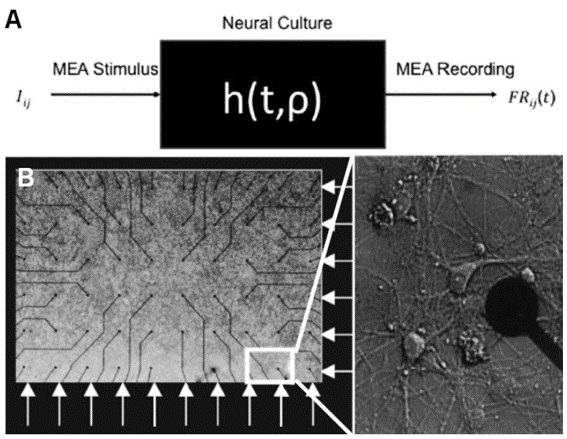
One natural approach to overcome these limitations is directly recruiting biological neurons into biosynthetic computers, which harness the processing power of neural cells and their interconnected networks to perform cognitive computations.
In prior work, as early as the 2000s, neurons were cultured on top of microelectrode arrays (MEAs). Electrical signals were sent back and forth between electrodes and neurons as simple global inputs and outputs. Based on the recorded global, network-level neuronal activities, these cultured neural networks have many potential applications. Despite these impressive proof-of-concept demonstrations, these neurocomputers work like “black boxes”: the specific details of connectivity, network topology, and activity within the cultured neural networks are completely unknown.
Synthetic Neurocomputers
To uncover the black box, we aim to create a neurocomputer platform that lets us extract the computing and learning algorithms of biological neural networks. By opening the black box, we hope to design “neuromorphic” or “cytomorphic” computing architectures that do not exist today.
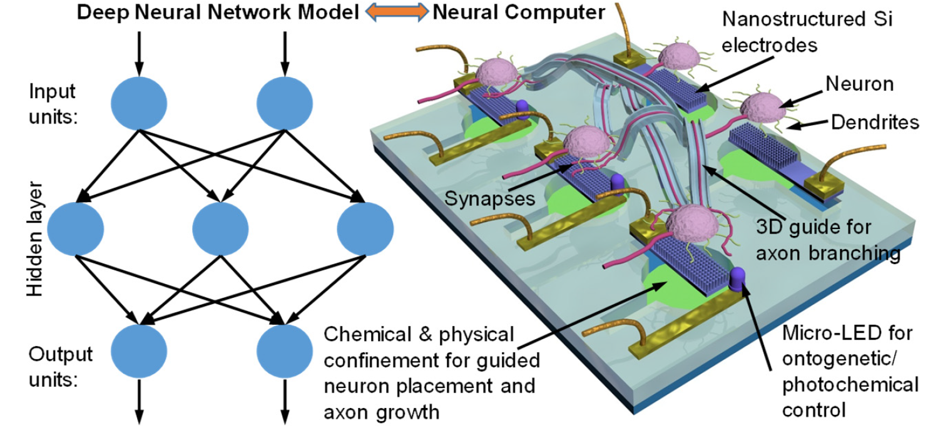
How will this platform work? The system contains three main parts. The first is a 3D guided culture of neural networks with complex but well-defined topologies, with controlled neuron growth at each node and axon branching across 3D bridges. Second, neurons at each node are interfaced with µLED devices, heterogeneously integrated through transfer printing. We use optical signals as input because they offer unique advantages, such as easily adjustable intensity as an analog input and biocompatibility when combined with optogenetics; LEDs are the preferred light sources for neural stimulation thanks to their small form factor and adjustable wavelength. Finally, we investigate how this optogenetic stimulation affects the network output at different nodes, which is captured by the third part of the system: transferred nanostructured silicon electrodes.